
14 Frequently Asked Questions
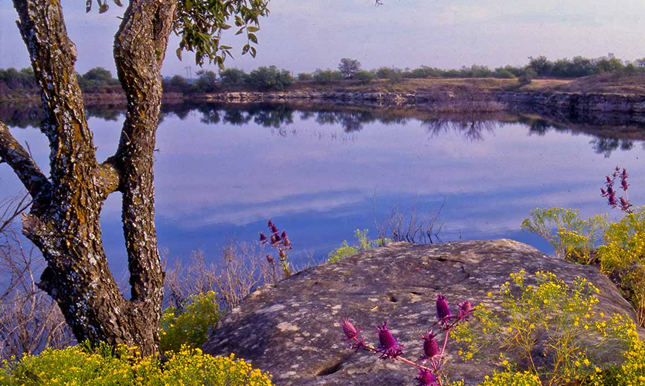
Hard rock quarries become pristine lakes after completion.
1. Where is the proposed quarry located and what is the size?
The proposed active quarry will start at and grow about 1 acre per year and reach only 10 acres in 10 years surrounded by about 190 acres, east of Trollhaugen (see Maps tab). Since this is primarily a ground level operation with visual buffers, the quarry will always have little if any visibility from adjoining property.
2. There is talk about new jobs for area residents. What’s the full story?
The new quarry will generate an estimated 20-30 new jobs. Of these jobs, 8-10 jobs will be within the quarry and 10-15 will be independent truck driving jobs providing trucking service for the quarry. Another 10 jobs are projected by the WI Dept. of Workforce Development – Office of Economic Advisors as indirect area growth jobs from the quarry operation.
In Polk County, underemployment is well known, as are foreclosures on families struggling to make ends meet. These new jobs will help many families who are facing economic difficulties and uncertainties.
2. Are these good paying jobs?
Yes. The jobs are estimated to equal over 30 box-store or light manufacturing jobs. The hourly quarry jobs themselves pay around $70,000 per year. And most of these good pay and good benefits quarry jobs will be filled by local people.
3. What about experience required for those quarry jobs?
Quarry operators hire most of their new people with no experience required. If you live in the area, are a hard worker and want to learn a new skill, you have a chance. Quarry land owners and operators are known for rewarding the areas where they operate – with jobs and with additional local support.
4. What does this mean for Polk County?
The quarry operator is projected to annually pay $30,000 in local property taxes, $15-$25,000 in Polk County sales tax and generate $500,000 in area spending revenue.
5. Is it correct that the new quarry property is protected by the DNR of Wisconsin?
Wisconsin recognizes that Natural Resources, including lakes and mineral deposits, are an economic benefit to the state. To that point, the new Blue Rock quarry property was issued a DNR Registration to protect this natural resource. Wisconsin minerals, such as trap rock, are valuable to the state and everyone benefits from this natural resource. Trap rock is used from highways and bridges to shingles and landscaping. If you have a driveway, concrete, shingles or landscaping at your home (and we all do) you are benefiting from a quarry.
6. Who will operate the new quarry?
Who the new contracted operator has not been decided. However, there are interested operators and they will be contacted. It is a major process involved in selecting a safe, experienced and environmentally sound operator. The Blue Rock families take this contractor selection process and the contract agreements very seriously. We are dedicated to making this agreement a benefit for everyone involved yet balanced with full respect for our environment and the concerns our neighbors may have.
7. Will this quarry be like the existing trap rock quarry?
In answer to the question, it is both yes and no. Both quarries have very slow growth patterns (the other quarry, Dresser Trap Rock, is over 100 yrs old). Although our new quarry sits on 200 acres of land, it will take 10 years to use the permitted 10 acres of extraction. The additional 10 acres for processing will remain relatively constant If extraction expansion is requested after 10 years and if permission is granted from both the County and the Town. Our new quarry will continue its slow growth and then go through reclamation closure and quite likely become a lake. New quarries have the latest in equipment and processes and meet all current Federal/State laws. It is planned that the majority of rock will be shipped by rail. Vehicle traffic increases on any of the access/exit roads will be less than 5% (from WI DOT Traffic Counts).
8. We already have a trap rock quarry in Dresser, why another?
The current quarry in Dresser, at present levels, is not keeping up with certain grades of rock. Highways, schools, homes all need or require high grade hard rock such as traprock. For federally funded roads it meets the strict requirement that only traprock or granite can meet. There is enough market (and different markets) for two suppliers.
Actually, there was another quarry located exactly where our proposed quarry is now. In 1918, a company started the Scarlet Stone quarry to market red trap rock. The partners established a business but did not continue as the red trap rock ran out. Now, 100 years after that start, the project is ready to resume with traditional blue trap rock.
9. I’ve read concerns from critics. What are the facts?
The prior application by a quarry company was done over a 5 year period to satisfy all the known concerns, with testing and qualifications by some of the nation’s best independent experts. The results were compellingly positive. All qualifications required by Polk County were either met or exceeded.
The new quarry will be as safe, environmentally sound and as good a neighbor as the existing trap rock quarry who has been operating in the village limits for over 100. Nothing bad has happened there after 100 years nor will anything happen at our new quarry. It’s a basic quarry, similar to hundreds across the country and the current one within the Village of Dresser and the two next door in the Town of Osceola. The new quarry will operate according to the latest laws and standards set forth by the federal, state and local governments.
10. What are the concerns some folks have?
Other than NIMBY (Not In My Backyard) thinking, it’s water well issues and devaluation of property. To counter well issues and perceived damage to Lotus Lake, the new operation will stay above Lotus Lake (Dresser Trap Rock is over 200 feet BELOW neighboring Poplar Lake) and above registered area wells. There are numerous quarries operating in the middle of residential neighborhoods across the country (for example, Burnsville & St. Cloud MN, Racine WI) – without any issues. Beautiful and expensive homes are often seen right next door to hard rock quarries. That’s a fact. Incompatibility or devaluation is just not the case and is proven across the country. And the Polk County CUP issued to Blue Rock clearly stated the operation is compatible. (see Map tab)
Anti-quarry rhetoric often uses the word “environmental” and proposes fears such as ground water contamination or blights on the landscape. Neither could be further from the truth. Quarries use no chemicals in their operations and recycle 90% of their water obtained from a private, state approved high capacity well. (The Village of Dresser consumes more water in one month than Blue Rock will consume in two years.) As for visuals effects, Blue Rock will use forest buffer zones around the property. Unless you are within the property or in an airplane, you will not see anything suggesting a quarry operation other than perhaps stock piles from where loading is done. Blue Rock treats our environmental and neighborhood responsibilities very seriously and with contractual obligations for the life of the operation. Hard rock quarries rarely, if ever, have EPA violations. Blue Rock believes in a good-neighbor policy to the area & the environment.
11. What about the truck traffic?
The bulk of rock is planned to leave via rail provided by the CN Railroad. The balance is trucks which we propose to regulate via alternate routing to prevent grouping through Dresser. (Yet another new Blue Rock initiation.) There are three major county highway routes from the quarry that will be used. Based on the most recent WI DOT traffic counts, traffic going on State Street in Dresser will increase by less than 2%. (see Wisconsin Dept. of Transportation tab)
12. The quarry is near Lotus Lake. Is that a risk?
Hard rock quarries are very immune to draining any liquids. This is mainly because hard rock quarries are very solid, much like a plastic bowl. Our current quarry CUP limits the depth of the quarry to be above Lotus Lake. (Dresser Trap Rock is over 200 feet BELOW neighboring Poplar Lake) All registered private wells are deeper than Lotus Lake. Since hard rock quarries hold liquids, they do not drain significant water from elsewhere either. You’ve noticed that most wetlands and ponds occur in low areas? One of the Blue Rock quarry buffer zones actually has a wetland – in a high area as the rain water cannot drain out from the rock bed. The water experts and the WI DNR have expressed no concern about the quarry impacting Lotus Lake any more than the existing hundred plus deep private wells around Lotus Lake are draining the lake. Minimal water is used in the quarry process and what is used is 90% recycled. Rain water, because it is not absorbed, often is pumped out of quarries and used in the processing. Blue Rock will use less water in 2 years than Village of Dresser uses in 3 months!
13. The railroad, Canadian National (CN), how do they play into the project?
Canadian National owns the track that runs from Dresser into Minnesota. They currently provide the track for the tourist train in Osceola/Dresser. It is well known that CN needs additional revenue to keep the tracks operational. This could be from their own trains that would be hauling rock from the new Blue Rock quarry. CN supports the new quarry as it will keep their track active, profitable and available for the tourist train. Enough said. The area benefits from the track staying in place. The new Blue Rock quarry will help guarantee that. And the quarry property owners are themselves avid tourist train supporters.
14. What are the next steps?
Blue Rock will continue to inform the public and proclaim the truths about our proposal. For those interested, presentations are available to groups. Any and all questions are welcomed. Also, Blue Rock has tours available for the Glades Nature Area where you can see our park concept that is under construction. This 30 acre zone contains inspiring natural basalt rock outcroppings and cliffs similar to a visit at Interstate Park. (Contact us for a free presentation or tour.) The Glades Nature Area and the potential extension of the Stower 7 Lakes Trail through the park is another part of our commitment and neighborhood contribution to the community. (see Glade Nature Reserve tab)
Closing Comments.
Investing in a community and sharing the benefits of a project is the intent of the Blue Rock Quarry local property owners. Polk County Environmental Services Committee and the Polk County Board of Adjustment has confirmed and supports our goals by issuing and reaffirming a Conditional Use Permit and agrees that our quarry will both advance the lives of many of their residents and provide welcomed new revenue to the county. Be informed and decide what is best for Polk County and the Town of Osceola. We hope that as you learn more about the truth and the science, you will join many others who support our work and this great new business opportunity. (see Contact Us tab)
 Blue Rock Quarry